

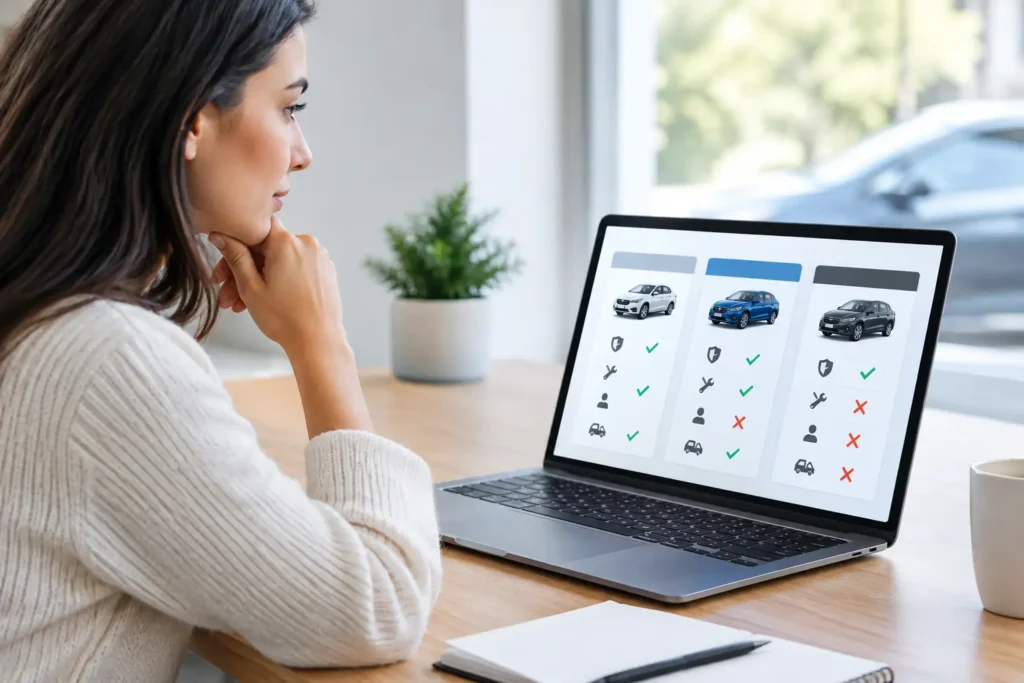
A quote that costs $40 less per month can still be the more expensive choice if it leaves you with a large out-of-pocket bill after a serious accident. The key to how to compare auto policies is not collecting the most quotes. It is making sure each quote is built around the same protection, then deciding which combination of coverage, price, and service fits your household.
Auto insurance is easy to compare poorly. A declarations page is full of numbers, abbreviations, and options that look similar from one carrier to another. Start by looking beyond the premium. The questions that matter are: What does the policy pay for? What are you responsible for paying? Who will help when you need to use it?
How to Compare Auto Policies on Equal Terms
Before you compare prices, make the quotes as close to identical as possible. If one quote has higher liability limits, a lower collision deductible, rental reimbursement, and roadside assistance while another does not, you are not comparing the same product. You are comparing two different levels of financial exposure.
Begin with the vehicles, drivers, annual mileage, garaging address, and usage. A vehicle used for a daily commute, business errands, rideshare activity, or occasional recreation may need different treatment. Be accurate here. Incorrect information can lead to a changed premium or coverage issue later, depending on the policy and carrier.
Then ask for the same core coverage choices on every quote. This gives you a clean baseline. Once you see the baseline price, you can decide whether it makes sense to adjust a deductible or add an optional coverage.
Start with liability limits
Liability coverage pays for injuries or property damage you cause to others in a covered accident, up to the policy limits. State-required minimums may allow you to register and drive a vehicle, but they may not be enough to protect your income, savings, home, or future earnings after a major loss.
Liability is often shown as three numbers, such as $100,000/$300,000/$100,000. The first number is the maximum for injuries to one person. The second is the maximum for all injuries in one accident. The third is the maximum for property damage. A newer truck, several damaged vehicles, or a serious injury claim can make low limits look inexpensive only until they are needed.
The right limits depend on your assets, household income, driving habits, and comfort with risk. Higher limits generally cost more, but the difference is sometimes smaller than people expect. Compare the actual dollar difference rather than assuming stronger liability protection is out of reach.
Compare deductibles with your cash reserves
A deductible is the amount you pay before collision or comprehensive coverage contributes to a covered vehicle loss. Collision generally applies when your vehicle strikes another vehicle or object, while comprehensive covers many non-collision events, such as theft, hail, vandalism, falling objects, or animal strikes.
A $1,000 deductible may reduce the premium compared with a $500 deductible. That can be reasonable if you have $1,000 available when a loss occurs and would rather keep the monthly cost lower. It can be a problem if paying that amount would force you to delay repairs, use high-interest credit, or go without transportation.
Check collision and comprehensive separately. Some drivers choose a lower collision deductible because accidents are a more immediate concern, while accepting a higher comprehensive deductible. There is no universal answer. The practical choice is one you can afford to pay promptly if your car is damaged.
Look Closely at the Coverage Around the Car
The vehicle itself is only part of the risk. A useful auto policy also addresses what happens when the other driver is uninsured, when you need a temporary vehicle, or when an accident leaves you with medical bills.
Uninsured and underinsured motorist coverage can help in certain situations when the at-fault driver has no insurance or not enough insurance. Availability and details vary by state, carrier, and policy. This coverage deserves more attention than it usually gets because another driver’s low limits can become your problem after a serious crash.
Medical payments coverage or personal injury protection may also be available, depending on the state and policy. These coverages can work differently from health insurance and may help with certain medical expenses after an accident. Ask what the coverage does, what limits apply, and whether it has a deductible or coordination rules.
Rental reimbursement is another common comparison point. It can help pay toward a rental vehicle while your covered car is being repaired after a qualifying loss. Compare the daily rental amount and the maximum number of days, not just whether the option appears on the quote. A low daily limit may not cover a comparable rental vehicle in your area.
Roadside assistance can be worthwhile for some households, particularly those with older vehicles, teen drivers, or frequent road trips. Review the actual services and limits. Towing distance, lockout help, battery service, and tire changes may be handled differently across policies.
Check What Is Excluded or Limited
Insurance is defined by both what it covers and what it does not. This is where a quick online quote can leave questions unanswered.
Ask about exclusions or limitations that relate to how you use your vehicles. Delivery driving, business use, rideshare work, custom equipment, permanently installed accessories, trailers, and regular use of a non-owned vehicle can all affect coverage. A personal auto policy may not respond the same way when a vehicle is used for business activity.
If you finance or lease a vehicle, ask about gap coverage. If a total loss occurs, the amount owed on the loan can be greater than the vehicle’s actual cash value. Gap coverage may address some or all of that difference when included and applicable, subject to policy terms. It is not automatically part of every policy.
Also verify whether replacement cost, new car replacement, accident forgiveness, deductible waivers, and glass coverage are included, optional, unavailable, or subject to conditions. These features may be useful, but they should be evaluated on their terms rather than treated as automatic upgrades.
Evaluate the Insurer and the Service Behind the Quote
Price and coverage are the foundation, but service matters most after an accident, theft, or storm damage. Consider how you prefer to communicate, whether you want a named point of contact, and how easily you can get clear answers about changes, billing, or a claim.
A direct insurer may suit someone who prefers to handle every step online. A captive agent represents one insurance company. An independent agency can compare options from multiple carriers while giving you one person to call when you have questions.
At Platinum Insurance Group, clients can work directly with Grayson Tripp rather than a call center. We offer comparative shopping across multiple carriers, and clients are invited to request an annual policy review and re-quote at renewal. If a claim happens, we can help you through the process and follow up with the carrier. The carrier makes coverage and claim decisions, but you do not have to sort through every question alone.
Avoid These Common Quote Mistakes
The biggest mistake is choosing the lowest premium before checking limits and deductibles. The next is comparing a six-month quote with a 12-month quote without converting both to the same time period. Payment-plan fees, paid-in-full discounts, and the effective dates can also make two prices appear more different than they are.
Do not assume every discount is permanent. Some discounts depend on driver records, policy bundling, payment method, mileage, vehicle equipment, or a carrier’s underwriting guidelines. Ask which discounts are included and what could cause the price to change at renewal.
Finally, do not treat the policy declaration page as something to file away unread. Review it when it is issued and after major changes: a new driver, vehicle purchase, move, marriage, divorce, home purchase, business use, or a substantial change in mileage. These moments can change both your protection needs and the quotes available.
A good auto policy comparison leaves you with more than a lower number. It gives you a clear picture of what you are buying, what you may pay after a loss, and who you can call when the details matter.